


15 great curve-handlers that won’t gouge your wallet.
Note: The featured products are available from Woodcraft Supply unless otherwise mentioned. Abrasives sold separately.
No matter how carefully your work has been sawn, routed, or turned, odds are good that it will require some degree of final sanding before it’s ready for a finish. While sanding flat surfaces is a relative cinch, sanding curves is a different story. Making fair curves scratch- and facet-free requires a different strategy and the right sanding accessories.
The low-cost accessories you’ll find on these pages can’t compete with a stationary spindle or belt sander, but they can serve as a solid starting point for beginners and as valuable problem solvers for well-tooled woodworkers. Depending on the task, these little specialists offer comfort, control, and convenience not provided by larger machines, without the risk of damage from over-sanding. In addition, a few items enable you to enlist non-sanding machines that you may already own, saving money and shop space.
After trying my hand at a wide assortment of abrasives, I found that most items fall into a few problem-solving groups. Although the items within each group perform in a similar fashion, each possesses certain attributes that gives it an edge. By paying attention to cost, control, and sanding efficiency, you can cherry-pick the sanders you need to round out your existing arsenal. Considering that you may encounter a few unexpected curves down the woodworking road, you may want to store this article with your sandpaper.
 Sanding Drums
Sanding drums rank as one of the most popular smoothing and shaping solutions for plenty of good reasons. In addition to affordability, rubber drums work with any chucked tool that accepts a 1⁄4" shaft and are available in a wide range of diameters to complement almost any curve. Smaller-diameter drums can be easily coupled with a portable drill or flexible shaft; larger diameter drums are best reserved for use on a drill press, lathe, or independent motor. While outfitting a drum on a drill press transforms the machine into a decent spindle sander, note that the machine’s bearings aren’t designed for heavy side loads. Before starting an extended sanding session, upgrade your sanding drum set by adding a support bearing (see inset, above) to prevent quill damage and to maintain a square edge.
If you regularly use one drum more than the rest, you might want to go sleeveless. A single foam drum costs more than a basic set, but this sander’s ability to accept regular sandpaper sheets helps ensure that you’ll have fresh abrasive (in a wider range of grits) close at hand. Considering the number of drums you can wrap from a sheet, compared to the cost of a sleeve, you can easily recoup your initial investment.
Pneumatic drums are the most expensive option but offer the most flexibility. These inflatable accessories enable you to vary the hardness of the drum to suit the job. For example, it helps to increase the pressure for general shaping and for working inside curves. On the other hand, to clean up outside curves without cutting fresh facets, let out a little air. Like sleeveless drums, pneumatic drums are sold individually in a variety of diameters, plus a few unique shapes. The ball-nosed drum reaches into spots where other sanders can’t, making it a handy problem-solver for concave surfaces such as spoons, bowls, and chair seats.

2"-long Drum Set, #07P41, $17.99 (includes 1⁄2", 3⁄4", 11⁄2" and 2"-dia. drums)

Drum-Sander Bearing 68Z02.20, $18.90 (Lee Valley)
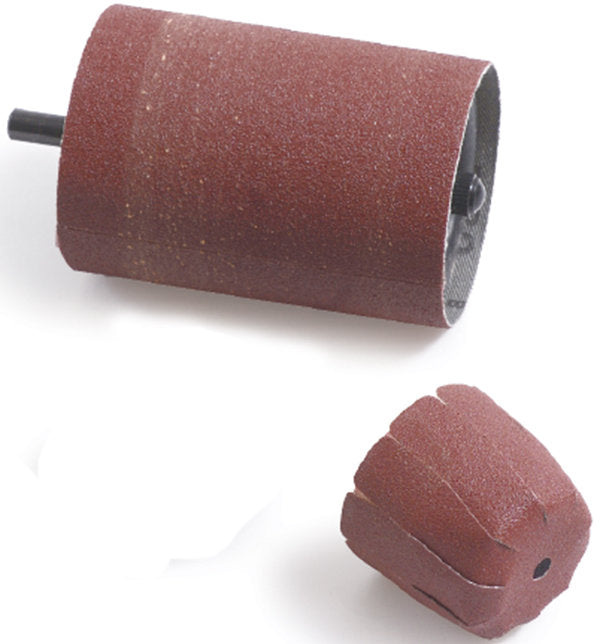
Pneumatic Drum, 21⁄2" dia. × 31⁄2", 68Z50.01, $34.50 (Lee Valley)

Round, 13⁄4" dia., #147535, $43.99

Sleeveless Drum 21⁄2" dia. × 41⁄2", #06P14, $28.50

1" dia. × 3", #06P21, $24.25
 Flap Sanders
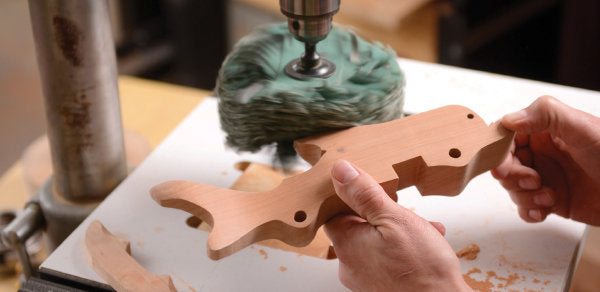
Flap sanders (some types are called finishing mops) consist of abrasive strips that can reach deeply into profiles without destroying detail. These soft-headed sanders quickly buff out minor scratches, but tend to burnish overlooked blemishes not removed by coarser abrasives. For this reason, flap sanders are best used after initial shaping and sanding with a drum or another more aggressive accessory.
The largest models are designed to be easily refreshed or replaced for efficient operations. The strips on the mop above can be removed by unscrewing the lock nut. In addition to replacing the strips, you can add end washers or spacers to adjust the sander’s flexibility and aggressiveness.
Taking a different approach, the Sand-O-Flex (at right) stores standing strips within its plastic body, with the projecting ends of the strips backed by stiff bristles attached to the sanding head. When the abrasive wears, simply loosen the knurled knob, pull out a fresh section, and continue sanding.
Larger mops are easier to control on a stationary machine, but smaller flap sanders and star sanders pair nicely with portable tools. Flap wheels employ strips of nonwoven abrasive between abrasive strips to maintain the sander’s shape, even when pressed into concave curves. The bundle of abrasive strips on flat-flapped stars flexes to better negotiate convex curves. When using either accessory, realize that these flexibly-mounted abrasives cut less aggressively than drums or blocks. (I found that the 60-grit mop performs like a 120-grit drum). Bearing down on the work usually ends up burnishing the surface. If you need to fix a blemish, go back to a drum, or use a hand-sander.
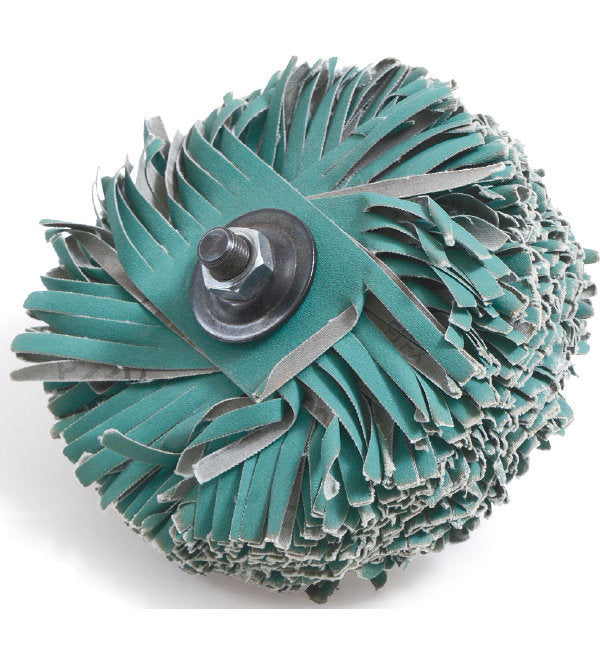
Double Mop, 6" dia., $76.95 (rjrstudios.com)
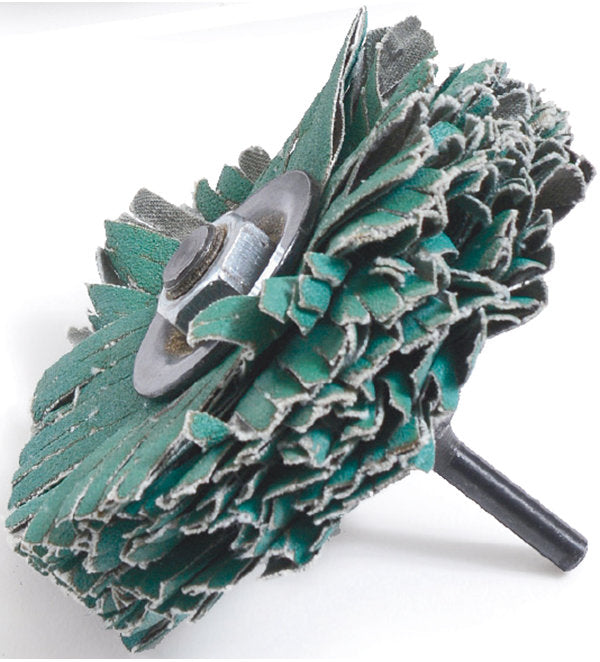
Single Mop, 4" dia., $29.95 (rjrstudios.com)(additional sizes and grits available)

Sand-O-Flex, 7" dia. × 1", #06L31, $55.99

Flap Wheel, 31⁄8" dia. × 2", 68Z26.01, $39.90 (Lee Valley)

2" dia. × 1" 68Z25.01, $21.90 (Lee Valley)

Sanding Star 4" dia., 220 grit, #18Q95, $20.50 (additional grits available)
 Lathe Sanders
Abrasives used to smooth turnings–often while spinning–need to be aggressive enough to remove tool marks and refine curves while remaining flexible enough to avoid gouging the work.
For spindle work, reach for the hand-sanding pads shown on the opposite page, and let your lathe do the work.
For face work, such as bowls and platters, you have two options: With a disc, you can turn a portable drill into an effective sander. The soft neoprene pad conforms to hard-to-reach areas such as the inside edges of lipped bowls. These sanders come with hook-and-loop interface pads to adjust firmness and to protect the hooks on the disc from heat damage that could cause the sanding discs to disengage. The disadvantages to this drill-powered disc system are its weight and its inability to reach into narrow openings.
With its freewheeling head, a rotary sander works like a drill-powered disc, but the rotation comes from the spinning wood. This quiet operator does not leave swirls and is easier to negotiate into bowls, but it’s not as aggressive as a drill-powered disc, especially across the center of the work. Note: With both types, stick with wave-edged discs. The profile prevents the edge from digging into your work.
For super-smooth surfaces, finish up with scuff and buff balls. Easily mounted on a drill or flexible shaft, these balls are comprised of a stack of abrasive discs fastened onto a metal shank. The wavy design follows curves without any risk of gouging or burning. Unlike steel wool, nonwoven abrasive pads do not shred and can be rinsed clean with water.


New Wave 2" Sanding Kit #142960, $47.99

New Wave Scuff & Buff Balls White (polish), 2" dia., #154585, $15.50

Maroon (medium), 2" dia., 154583, $15.50

Tailed Sanding Apprentice
Even cordless drills can get cumbersome. If you see a significant amount of sanding in your future or are looking for more comfort and control, consider a flexible shaft. Before you invest in a stand-alone system, consider buying just the parts you really need. Outfitted to your drill or lathe, this solution is quiet, powerful, and makes sanding as easy as holding a pencil. The Jacob-style chuck grips shafts up to 3⁄8" in diameter.
 Hand Sanders
There’s no getting around it: For the best possible finish, plan on spending some time unplugged. In addition to offering superior control, hand-sanding quickly reveals scratch marks and inadequate machining. Admittedly, sanding parts by hand takes more time and requires some elbow grease, but considering the cost of proprietary drums and belts, not to mention the hassle of getting a replacement when you run short, it’s easy to appreciate how quickly these pads can earn their keep.
For large sweeping curves, reach for a foam pad. The 1"-thick soft foam disc has plenty of give to conform to large-radii concave and convex surfaces, and the hook-and-loop backing makes it easy to borrow discs from your power sander. Closed-cell foam Soft Sanders are firm enough to keep their shape even in heavier sanding. By selecting the profiles that match your work, they can handle everything from erasing burn marks to finish sanding, with little threat of rounding existing profiles. To finish up tight coves, beads, and grooves, you’ll want a set of rubber sanding pads.
The most significant advantage to these pads is that they work with standard sandpaper. For extended sanding sessions, affix the paper to the pad with spray adhesive, or spring for adhesive-backed sandpaper.

Hookit, 5" dia. × 1", Hand Pad #157182, $19.99 (Japan Wooworker)


Sanding Pad Set #145961, $10.99 (12-pc. set)

Norton Soft Touch Sanding Sponges $2.25 (various grits available)

Norton Sanding Sticks $3.99 (various grits and sizes available)

Sponge Sanders
A high-density foam backing enables Norton’s Soft Touch sanding sponges to easily follow contours without the tearing or cracking associated with wrapping ordinary paper abrasives. In addition, the backing cushions the grit, producing a super-even scratch pattern. The Soft Touch line offers the finest grits (up to 1500), making them a standout choice for finish-sanding pens, bowls, and other turned items.
Norton’s sponge blocks are significantly stiffer than the sheets, making them better able to reach into tight spots without backup. The blocks can also be trimmed with scissors to squeeze into tight spots. Available in grits from 60 through 220, these blocks are better suited for more demanding jobs such as removing paint or sanding metal.
Both sponges can be used wet or dry and can be refreshed by simply rinsing them out in water and allowing them to dry.