

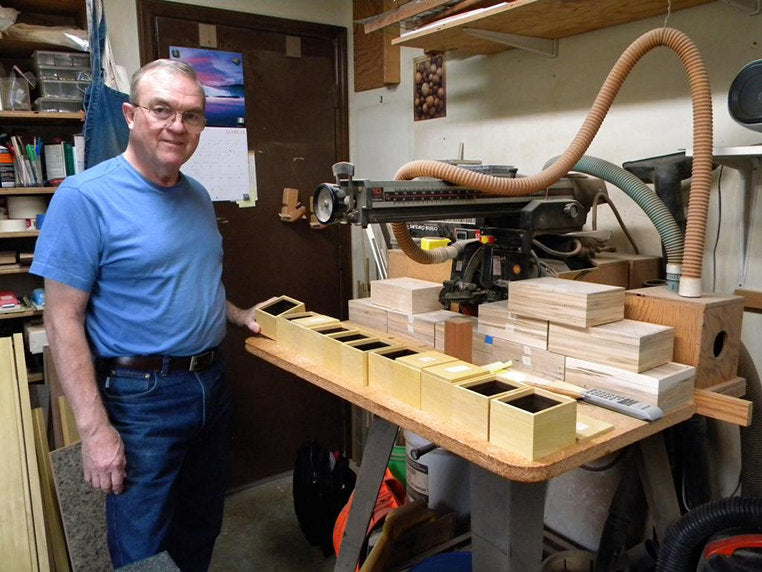
By the title, one might think that this blog is about problems in woodworking. On the contrary, “Wood Frustrations” is about creating problem solving in woodworking. “Woodcrafted” puzzle solving that is, by Tom Lensch of Centerville, Ohio, who makes wooden puzzles of all shapes, and sizes collaborating with puzzle designers from around the world. Now its not a frustration building them, but it could be a real frustration trying to figure out how they go together!
History of these traditionally made wooden puzzles dates backs to the beginning of the 18th century in England, but the Japanese market took these over in the 19th century. They developed a multitude of games in all kinds of different shapes of animals, houses and other objects, whereas the development in the western world revolved mainly around geometrical shapes. The Japanese word, “kumiki“ means to join wood together. The term “burr” is also used, meaning interlocking puzzle.

In an interlocking puzzle, one or more pieces hold the rest together, or the pieces are mutually self-sustaining. The aim is to completely disassemble and then reassemble the puzzle. Both assembly and disassembly can be difficult, contrary to assembly puzzles, these puzzles usually do not just fall apart easily. The level of difficulty is usually assessed in terms of the number of moves required to remove the first piece from the initial puzzle. The image shows one of the most notorious representatives of this category, the Chinese wood knot. In this particular version designed by Bill Cutler, 5 moves are needed before the first piece can be removed.
With the help of today’s computers and software, it has become possible to analyze complete sets of games played. This process was begun by Bill Cutler with his analysis of all the Chinese wood knots. From October 1987 to August 1990 all the 35,657,131,235 billion different variations were analyzed. The calculations were done by several computers in parallel and would have taken a total of 62.5 years on a single computer. You can see why it would take a mathematician or in this case a “mathemagician” to analyze this data.
A majority of puzzle designers are typically mathemagicians. Lensch being a former civil engineer with a mathematical background is one such mathemagician. From the early age of 9, Lensch began collecting puzzles, and his study on how to make them from a book he acquired called Puzzles Old & New How to Make and Solve Them, written by Jerry Slocum and Jack Botermans. He started building the puzzles and then selling them at local wood, and craft fairs. In addition the author, Jerry Slocum is a specialist in the field of mechanical puzzles and the 1978 founder of the annual “by invitation only” International Puzzle Party (IPP), in which puzzle designers, builders, and traders gather for this worldwide event held in a rotating schedule between North America, Europe, and Asia. Slocum is also the founder of the Slocum Puzzle Foundation.


It was through 2 puzzle collectors that Tom went on to meet a group of collectors, designers and craftsman in 1993 and was invited to attend a Gathering for Gardner, a famous puzzle solver, mathematician, and mathemagician for the late Martin Gardner. There he met Bill Cutler, also a mathematician and Metagrobologist. Bill asked Tom if he would make and sell his puzzles. From that experience Tom was able to attend his first IPP, and has collaborated with Cutler and other puzzle designers such as Oskar van Deventer, Stewart Coffin, Frans de Vreugd and Dic Sonneveld.
The puzzle collection above are just a few of the puzzles Tom has made for these designers. The puzzle in the left bottom corner of the photo is made from bubinga, holly & ebony called “Torture“. Click on the photo for more information.
Right is a bristle burr puzzle designed by Oskar van Deventer, and built by Tom Lensch.
The puzzle pieces above (called “Four-Fit“) are made from marblewood with a poplar tray, designed by Stewart Coffin, and crafted by Tom Lensch.


More of Tom’s puzzles:


Just a “few” more of Tom’s creations & collection:
Our interview with Tom Lensch,
Get started at Woodcraft today with your baffling wooden puzzle collection with puzzle pen inlay kits, wood puzzle design guides, scrollsawn puzzles, plans, projects and much more.